
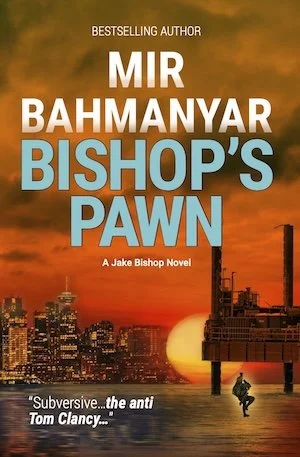
Bishop’s Pawn First Chapter
Prologue
Concentration Camp Buchenwald, Weimar, Germany, April 11, 1945
A low fog obscured the countryside as sun gave way to night. But the fog and the encroaching darkness could not conceal the horror of the camps spread around a wooded hill. The main concentration camp, the Konzentrationslager Buchenwald, had just been entered by the Americans of the 6th Armored Division, nicknamed the Super Sixth, and its soldiers, who had experienced the horrors of combat, wished they had never set foot in this place of evil or seen the horror it held.
US Army intelligence officer First Lieutenant John Hamilton, still in his late teens, simply stared at the sign above the gate facing the inside. It was in German and read Jedem das Seine. The message was clear and harsh: To Each His Own, you got what you deserved, and the master race was going to make sure of that by incarcerating and systematically murdering undesirable human beings, most of them Jews, when they had built Buchenwald camp in 1937. They had failed, and they had failed big. The cost had been high for the Allies, but Hamilton knew they had won and won big. The Nazis and their allies were crushed—seventy million people died during the war—and soon only the Soviet Union would stand in the way of true democracy for the world. What he saw at Buchenwald confirmed his convictions.
The inmates had liberated the camp earlier that day. The Schutzstaffel guards, the SS, had fled knowing the Americans were approaching. When the soldiers first arrived, the prisoners had picked them up and thrown them jubilantly into the air. That is, those who still had any strength left. But even that joyful experience was overshadowed by the tens of thousands of dead inmates starved, murdered, and worked to their deaths and then piled high or buried throughout the area. The stench of death and decay was overwhelming. The survivors looked like living cadavers. Touching them was repulsive. All of this, this horror, this sacrifice, had to mean something, thought Hamilton.
Later that night inside the dimly lit SS commandant’s villa just outside of the main camp, Hamilton and two other American officers smoked cigars and drank expensive French wine, stolen during the occupation of France, no doubt. They had argued for hours, interviewed important survivors, including allied prisoners of war. They finally agreed. One of the officers went out and returned with two former prisoners, one a Danish banker, the other a Russian intellectual. The five men shook hands and sat around the table. Cigars and wine were made available to the new recruits. There was a lot to discuss and plan. The fate of the world was at stake.
Early in the morning, the deep conversations abated, and Hamilton stared at the single piece of art on the wall. The oil painting depicted a medieval vessel, a kogge, struggling through a powerful, dark storm. He nodded to himself. Yes, like a ship steering through a storm to safety, he thought. He reached for an oversize ledger, crossed out the swastika with a fountain pen, and drew a stylized kogge.
“Fellas, a toast,” he said.
They lifted their glasses and shouted fanatically.
A drop of red wine spilled from John Hamilton’s lips and exploded into a blood-red splatter on his hand-drawn logo on the journal. It spread quickly, like an inkblot.
Chapter 1—Neptune’s Sons
The Gulf of Mexico, Today
The orange blossom of the sun disappeared into the horizon. Its brilliant rays were lost to the murky dark blue water surrounding a multistory gas and oil platform known as a GOPLAT. Two tall cranes flanked the central derrick, bracketing its deck. A helipad was tucked away into the northeast corner. On the deck below, a sign read Western Hemisphere Oil Company—The World’s Energy Provider, Gulf of America. From the air, the GOPLAT looked like a giant mechanical spider hovering over the water with long tentacles reaching into the gulf. Its job was simple: to drain oil from the earth just as a vampire drains the blood of its victims. Darkness devoured the platform, betrayed only by its lights.
Hidden beneath the moonless night, where the structure met the gulf’s waters, two heads slowly rose to the surface. The divers pushed their masks to their foreheads. Holding onto the structure’s base, they slowly treaded water. United States Army Major Jamshid “Jake” Bishop looked at his longtime comrade, Master Sergeant Mike Brown. Mike’s eyes barely cleared the surface, reminding Bishop of a water moccasin. He’d operated with Mike for over a decade now,but time had not diminished either man’s addiction, their lust for combat.
Both were Tier 1 special forces badasses used for undercover missions by various intelligence agencies. Their current job was for the Pentagon’s Alternate Projects Division to act as liaisons with Naval Special Warfare Command. The maritime nature of the operation—assaulting and securing the GOPLAT they now clung onto—required NAVSPECWAR’s assets.
Despite misgivings about the lack of time and intelligence in the prep for the mission, Bishop felt positive. Adrenaline coursed through him. Dudes with guns and gear along with his best buddy Mike—what was not to love? Looking at his watch, Bishop lifted his hand with all fingers and thumb extended. Five minutes to go, 0325. Mike nodded an acknowledgment. More heads began surfacing around them. One by one, members of Gold Squadron, SEAL Team Six, rose from the abyss of the waters below, delivered by minisubmersibles fifty feet beneath the sea level, into the dark world above.
Bishop used hand and arms signals to ask the SEAL commander near him for a head count. The whispered count passed along the group of men came back correctly: fifteen plus Mike and Bishop. All had arrived safely. Bishop returned the SEAL leader’s thumbs-up with one of his own. There were still a few minutes to go. With diving gear already discarded, most SEALs conducted last-minute equipment checks while treading water. Some hurriedly attached their goggles and fins to their scuba equipment, releasing them to the bottom of the gulf. The only equipment they needed now was their combat gear and pneumatic launchers that would fire the grappling hooks and rope ladders to climb the GOPLAT.
Three minutes to go. Timing was everything. Three more groups of fifteen assaulters each spread around the GOPLAT’s structure, ready to do their thing at exactly 0330. They had timed their arrival razor-close to the assault time to ensure they wouldn’t be noticed, avoiding the cameras that monitored the GOPLAT’s central drill. So far, so good,thought Bishop.
A white-toothed smile from Mike glared starkly against his black skin. Bishop flashed back to the time he and Mike had been specifically tasked by the Pentagon with the mission. The seizure of the GOPLAT by an unknown terrorist cell had stung the intelligence community, which had completely failed to pick up any warning signs. Bishop was given final approval of the operation, and he knew better than to lead the actual assault. This was Navy SEAL territory, and the frogmen were more than capable of seizing the gas and oil platform to kill and capture the dozen or so terrorists nowintermingled with the crew. Apart from Mike, whose die-hard mantra Proper planning prevents piss-poor performanceguaranteed he’d make a few recommendations and alternatives, this op was pretty much NAVSPECWAR’s baby. His and Mike’s job was simple: interrogate the terrorists after SEAL Team Six secured the platform. They were to climb last.
The mission had been rushed, with less intelligence than Bishop would have liked. With the hurried planning and few resources on hand, the operation was a challenge. Drones were discarded during planning—too noisy. Satellite surveillance images weren’t available, since all satellites were directed to new emerging threats, real or imagined, by the Global South. Cutting off all electronic communications around the GOPLAT, however, was integral to the plan, and that was approved. The potential of terrorists using cell phones to remote-detonate IEDs strewn across the platform once attacked was considered plausible.
Bishop knew they had to make do with what they had and not what they wanted. The operational tempo of special operations forces capable of conducting this kind of mission had eaten up men and equipment. They were spread thinly across the globe, conducting missions against countless foes. As a result, Gold Squadron had been understrength, but NAVSPECWAR managed to find sixty men for this important operation.
It was now 0328. Bishop held up two fingers to the ST6 commander, who threw a quick thumbs-up. Bishop looked around the superstructure, barely making out a few heads in the dark. He carefully scanned his immediate area for any last-minute issues that could impede the operation. He saw none.
The sons of Neptune were moments away from dealing death to the terrorists who had seized an American oil rig in the middle of the United States–controlled Gulf of Mexico.
****
The gas and oil platform’s graveyard-shift crew worked frantically on the lit deck.
The foreman joined his boss, out of hearing of the exhausted crew. “We won’t last much longer. They need a break,” he said to his boss.
“Communications still down?”
“Yup. Weird. Worked fine until about a couple of hours ago. Almost like someone cut us off,” replied the foreman as he whipped out a can of Copenhagen chaw and fed his mouth like a coal-powered locomotive.
The boss watched as he shoveled in the chewing tobacco and said, “That’s gonna kill you.”
The foreman nodded in agreement. “Working through the night is the real killer. I need fresh men. Tired men make mistakes. We need more specialized crew and equipment. You told them last time you spoke, right?”
“They know. They did send that Canadian-Israeli engineer.” The boss took a long hard look at the crew. “They also reminded me of the contracts we signed. They’ll sue us if we shut down.”
The foreman stuffed more chaw into his mouth, his jaws chomping in white-hot anger. He took a deep breath. “Yeah, they know. They just don’t give a damn. That fat fucking engineer was worthless, if you ask me. He was wrong. We have a problem even if he said we don’t. I’m holding this together with Band-Aids. It’s gonna come apart at the seams, and then we’ll have a catastrophe worse than Deepwater Horizon. It’s buckling, I tell you. It’s gonna pop sooner than later.”
The boss reached for the nearly empty can of Copenhagen and packed chaw between his gums and cheek.
“Seems you and me are the only ones who give a shit,” grunted the foreman to no one in particular.
“Pretty much,” answered the boss.
“You have to call the authorities.”
The boss put his paw on his foreman’s shoulder. “You know the company will ruin us.”
The foreman shrugged his shoulders. “This whole area will be ruined. Jesus Christ, it’s the right thing to do. I can’t live with this. Can you?”
The boss took a minute. “No. Not like I can make a call right now, anyway. I suppose they will ruin us one way or another. Whatever happens, we’ll get the blame,” he reflected. “I see a bigger shitstorm brewing if we fail to keep this thing together. First thing when telecommunications are up, I’ll make the call and have the authorities shut us down. This sucks.” He formed a big chaw loogie in his mouth and spat it over the ledge into the dark waters below.
*****
The loogie’s flight was intercepted below by the shoulder of Major Jake Bishop where it exploded. Bishop froze. A nearby assaulter of SEAL Team Six’s Gold Squadron was prepping his pneumatic launcher. Bishop raised his fist. The man froze, even though his adrenaline was pumping and he was ready to fucking kill a bunch of raghead terrorists. Bishop stared up at the platform. Satisfied, he brought his arm down and tapped the SEAL on his shoulder. The launcher thumped its grappling hook high into the sky, angled toward the metal legs of the GOPLAT spider.
****
A mile away, an Army Task Force 160 Special Operations Aviation Regiment Black Hawk MH-60M helicopter hovered like a massive mosquito in the night sky, supporting the assault. The pilot and his navigator used their HUDs, their helmets’ heads-up displays, to control the helo. Their unit was the Night Stalkers, known as the finest special operations aviators in the world. The only cargo the Black Hawk carried was a single SEAL named Bud West, who was the sniper asset covering the assault teams. A bullfrog tattoo decorated his right forearm. He, too, was sent to the mission at the very last minute by someone in the Pentagon. He, too, was not from SEAL Team Six, although he replaced a sniper from their ranks.
The helicopter’s muffled engines buzzed like an annoying mosquito in the dark as the pilot urged it forward.
The SEAL sniper kept his eye on his watch.
****
Like the tentacles of a giant squid, ropes and ladders thumped out of the launchers, attaching themselves to the structure and pylons that held the GOPLAT afloat. Neptune’s sons climbed.
Bishop was the last diver on his pylon. He looked up and saw Mike salute him with a middle finger. Bishop held up his gloved hand, forming a W with his fingers for war. They shared the thrill of combat—it was all they’d ever known. They neither understood nor wanted peace. They dreaded the absence of violence. As Bishop started on the rope ladder, he spotted something out of the corner just below him. An intangible instinct invaded his body that made his neck hair tingle. He couldn’t quite make it out; a massive pylon obstructed his view. What the hell was that?
The soft sounds of water lapping against the pylon were interrupted when Bishop snapped his fingers to alert Mike a few feet above. Mike stopped his climb on the rope ladder, looked down at Bishop, and shrugged his shoulders, wanting to know what was up. They had developed an intuitive understanding over the years that served them well. Bishop pointed two fingers at his own eyes and then in the direction of interest. Mike expertly secured his foothold to steady himself. Holding his assault rifle with both hands, he aimed it toward where Bishop had pointed, while Bishop slung his weapon to climb down for a closer look.
Bishop was just above the waterline. He was certain he had seen something that shouldn’t have been there but couldn’t find it again. He scanned the area several times. Nothing. Better safe than sorry, he thought. He lowered himself into the water just behind one of the massive steel-and-concrete pylons. He felt an unusual surge of water bubbling up, centered in the middle of the GOPLAT, as though an underground explosion had occurred.
He gave a questioning look at Mike.
What the hell? he thought. It was his last.
The night exploded into a massive orange heat wave, shredding metal, concrete, flesh, and bones into near-atomic nothingness.