
Flashpoint Arctic:How climate change will compel a future war between the United States and Russia Part 4
The World by 2040
By 2020 the United States is the predominant global force despite the efforts of Russia and China. In 2020, the earth is warming at 1.15°C but is very likely to be 3°-3.5°C by 2040 because the Arctic is currently heating at least at twice that rate already. Predictions made in 2010 by scholars for 2040 foresee the Arctic to be sea-ice free with no possibility for war.[1] The polar bear, walrus, and whale will be nearly extinct with an increase in human activity. And war will come.
World consumption has quadrupled since 1970 but the population only doubled, and with annual material consumption establishing new records of 100 billion tons, securing resources is critical.[2] Global food requirements will increase by half while annual carbon emissions are expected to rise from 9 to 12 billion metric tons by 2040. [3]Population increase and prosperity will place additionally stresses on energy and raw materials to potentially triple of today’s market by 2050.[4] “There will be an increasing risk of discontinuous and systemic shocks to 2040 as a consequence of these factors and intensified resource stresses will bring new risks and uncertainties to international relations in an already turbulent world”.[5]
The greatest threat of 2040 will be the scarcity of water as global warming turns arable lands into deserts. The North Pole and South Pole along with the Himalayas, the Third Pole, will have been drastically melted resulting in greater sea levels and drastic reduction of fresh water for billions of people. Currently more than 500 glaciers have disappeared in the Third Pole.[6]
Food and water scarcities, extreme weather and floods will lead to mass migration as glacial melting and water disputes will arise in numerous parts of the world.[7] No continent or country however wealthy and powerful will be untouched. The world by 2040 will not be unrecognizable, it will however be different and inhospitable in many parts.
What then does a 3°C global warming look like? Large swaths of the earth will be uninhabitable because of desertification brought on by droughts. Rainfall will plummet in some regions and increase in others. For the United States this means the Colorado River, for example, will not be able to provide water to the tens of millions of people and agriculture depending on it as it falls to half its capacity. The Australian continent will bake under temperature increases. Extreme weather at a catastrophic Category Six will rip into the world. Water flows in Asia are impacted leading to a best-case scenario of millions of refugees. [8]
The worst-case scenario sees wars involving China, Pakistan and India. China and India may join forces against Pakistan or battle each other over resources. Russia may in fact support a war against any radical Islamist governments or non-state actors. A German army future trend report predicts a fragmented Europe.[9] Individual European countries will have to deal with large-scale migration exhausting their economies and leading to armed clashes and authoritarian governments. Mexico, Central and South America will see conflict with organized crime asserting itself, internal strife, and mass migration patterns. Australia and New Zealand are under Chinese influence with large scale influx of Chinese citizens. Africa will see an increase in organized crime and violence as its population migrates to hopeful pastures. Britain will seek to continue its special relationship with the United States but given new stress factors affecting America will see strains in the relationship as it simultaneously seeks to rebuild bonds it cut during Brexit with the European Union. Nordic and Baltic states will seek some form of neutrality vis-à-vis Russia and China.
The Russian Federation will see a growth of illegal migration and challenges along all its 16 borders. Climate change will alter its land mass as well. China will struggle with food supplies and will rely on imports. Perhaps it will have annexed Taiwan similar to Russia’s 2014 annexation of the Crimea. The common issues are illegal migration, lack of resources, and internal strife driven forward by an ever increasing and unpredictable changing climate.
The United States will be a society ruled by a super-wealthy oligarchy, supported by the military and high-technology complex. The rest of its citizens will be in the service industry. The southern border will see refugees while Americans will move north and into Canada fleeing extreme weather and financial destruction. The military will live in its city-bases, while highly educated technology workers live in super cities. The convergence of the military and technology, possibly with bio-engineering advances, needs to be fueled by ever decreasing raw materials.
The United States and Russia, with Chinese support, have the will to continue their duel. There will be war. What kind of war is impossible to predict.
The Coldest War (2040 – ongoing)
War according to Clausewitz is not just a duel on a larger scale but it is an act of force to impose one’s will on the adversary. It is ever evolving, a chameleon, and the outcome is never absolute. Significantly, “war is a mere continuation of policy by other means”.[10] All wars adhere to these timeless observations and that includes future wars.
Current War Theory
Current thought on future war rests on recent combat experiences primarily set in desert, mountain and urban settings. In the 1990s Marine Corps Commandant Krulak published a future war scenario called the Strategic Corporaldetailing the full spectrum and complexity of the next wars in which a corporal is tasked with transitions on the modern battlefield from humanitarian aid, to peacekeeping efforts between warring entities, and finally to a fight that turns increasingly hostile, lethal, and chaotic.[11] A war amongst the people. To this was added another task regarding psychological and information operations. The Four Block War addressed the full spectrum of modern hybrid warfighting.[12] One purveyor of hybrid warfare is Russia. Some of the ways it conducts hybrid war is by using information operations, proxy forces, political-economic influence, clandestine operation by its special operations forces, and traditional espionage.[13] Today’s hybrid wars are reliant on technology, are data driven, and do not use conventional forces. This, according to Rupert Smith, is due to parallel conflicts of the Cold War that exhibited new trends. It was, he argues, an end of the ‘Great Confrontation’ and a new paradigm emerged in 1991and became dominant where industrial armies became effectively obsolete.[14] The world’s most widely used tactic is counter-insurgency, based on colonial-era experiences in North Africa and Asia.[15] Smith identifies six main trends in the war amongst the people theory:
1) The ends for which we are fighting are changing – absolute objectives and war to individuals and non-state actors
2) We fight amongst the people – on the streets and bedroom via media
3) Our conflicts tend to be timeless
4) We fight so as to not lose the force rather than fighting using force at any cost to achieve objective
5) On each occasion new uses are found for old weapons – tools of industrial war are often irrelevant to war amongst people
6) The sides are mostly non-state [16]
The trends constitute a new form of war. War is no longer a single massive event of military decision that delivers a conclusive political result.[17]
Future War
Colin Gray proposes that in general a great deal of future war is known but the details of such war are not, instead the wars of the future do “not belong to small wars of an irregular kind; alas, it belongs to both regular and irregular warfare”.[18]
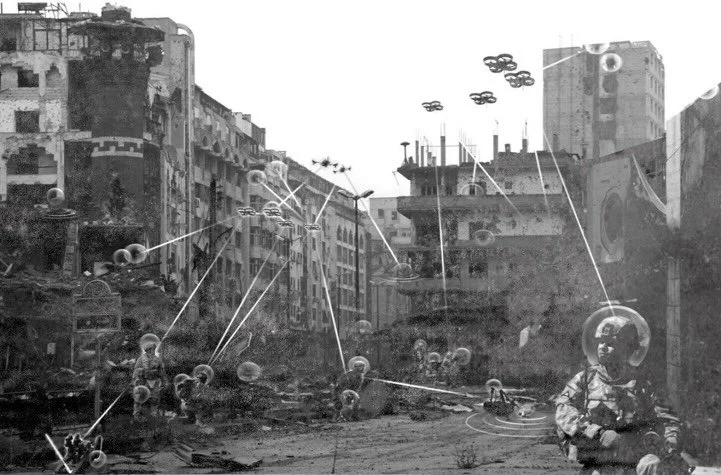
Future war envisioned in the urban environment. Image: War on the Rocks.[19]
The Russian vision of future war is further detailed by General Valeriy Gersimov who argues that the lethality of conventional weapons may in fact act as a deterrent similar to nuclear weapons.
The principal features of future conflicts will be the extensive employment of precision weapons and other types of new weapons, including robot technology…In the future, an increase in the capabilities of precision means of destruction, including hypersonic, will make it possible to shift the principal portion of strategic deterrence tasks from the nuclear to the nonnuclear forces”.[20]
General Robert Scales puts forth that technology, robotics and artificial intelligence, give credibility of a battlefield filled with automatons – a dehumanized version of an ideal war.[21] Clausewitz proposes that war is a contest of will and General Paul van Riper echoes this sentiment that war and future war is a contest of wills, not machines.[22]
Another concern for current and especially future warfare is the cost-loss ratio. General Michael Dana references the Battle of Midway in 1942 where the Japanese fleet lost four aircraft carriers in a single day and that would be unsustainable because in the future, a cheaply produced weapons platforms that can be used on land, sea, and air with great power and accuracy can destroy a carrier.[23] The Millennium Challenge wargame in 2002 intended to validate the RAM warfighting theory in the Persian Gulf, but proved its inability to sustain losses. Red team leader van Riper unleashed barrages of missiles, swarms of explosive laden suicide speedboats, launched attacks with commercial vessels, all without the use of radio communications, and destroyed the American fleet within 10 minutes.[24] Another example is the use of a $122 million aircraft to bomb the Taliban at a cost of $40,000 per hour totalling to $500,000 in flight time alone.[25]
Multi-domain warfare as practiced today is seen as the way forward for future war. For example, a multi-domain operation where
the objective is to disrupt an adversary’s command-and-control network could combine synchronized actions in the electromagnetic, air, land, sea, space, and human domains, which would require a host of entities to work together at a very high level. A cyber-attack on the adversary’s power grid, using access points developed months in advance, might require assets from the National Security Agency.[26]
However, Scales believes that future war lies in the tactical with ground troops. It will require small, independent, perhaps company-sized units led autonomously, but supported with massive robotics. Larger support units would be well removed from the open battlefield. He foresees a checkerboard pattern, reminiscent of the Roman Republican legion’s deployment called the triplex acies, but spread out over a great distance. The multitude of the small units would prevent an enemy from advancing without first having to destroy every single unit that is the eyes and ears of the larger battlegroups in the distance. But such an assault would prove difficult because each unit has a dome-like protection of sensors that theoretically provide early detection and would be able to request support, annihilating the attacking force. He further argues that micro-miniaturization will lead to the power of an Abrams tank reduced to an infantryman’s rifle.[27] He proposes that movement with all arms, or combined arms, on a practical level has changed since 1945 where divisions fought as a basic maneuvering element, and the destruction of Iraqi forces in 1990-91 witnessed the brigade as the driving platform, and perhaps in the near future “by 2025 it might be a company of all arms, possessing the power to employ every dimension of ground combat from maneuver to fires, reconnaissance, logistics, and the control of all external amplifiers.”[28]
Arctic War
It is impossible to predict future war. However, wars fought in 2040 will resemble current wars more closely. The time of bio-engineered, artificial intelligence integrated super soldiers is still well in the far future. The ethical and moral questions about creating new humans for war will be answered by its contemporaries. Another question is how many resources are available for the US? Will the United States still be mired in wars across the globe?
But the Arctic in 2040 will present a different challenge. Its geostrategic location pits the US directly against the Russian. There will be few if any proxies battling it out for their respective masters. A full-scale war is hard to imagine but possible as the competition for resources and access to strategic sea routes grow in importance. A war in the Arctic will be completely different, except for the dying and killing part, then wars in Afghanistan or Iraq for example. Human terrain teams will not be needed. The Arctic has few urban centers, is remote and sparsely populated. As such urban destruction similar to Mosul or Falluja, both in Iraq, will be absent. A war in the high north will see no concrete rubble, or sewers or fights close and personal unless it includes ship boarding and that presents its own challenges. Vast distances, poor infrastructure, difficult terrain, and extreme weather conditions present arduous areas of operations. American planes will not be able to stack for close-air support. Russian aircraft, perhaps inferior, will also challenge American aerial dominance.
How will the military operate under such conditions? The employment of drones seems reasonable as Scales suggests that small but powerful squads or platoons with the latest in lethal hand-held missiles, can independently operate under tough conditions. There certainly will not be any insurgencies to combat and as such decades of refined COIN practices will prove useless.
The war on America’s northern front will probably not be fought on land. The Arctic Ocean is more or less ice free and global warming is continuing to impact the snow and ice cover of the region. In all likelihood most of the fighting will take place in the maritime environment because of the easier access to the ocean and coasts. Ideally then one could employ raids on coastal installations and infrastructures. The seizure and destruction of Gas and Oil Platforms (GOPLAT) primarily led by special forces. These kinds of raids will force the Russians to either focus on key installations and leave other infrastructure open to attack or the military will have to spread across a longer coastline. Submarines will have limited use as they are more difficult to conceal without the protective cover of the sea-ice. Ships of the Russian Northern Fleet and those of the American 2nd Fleet may not directly engage other than in extreme circumstances but could cause tension or friction. Perhaps sabotage activities by SOF teams, military-civilian contractors or indigenous personnel will play a greater part than imagined. It seems difficult to consider convoy wars because a disruption to shipping, a center of gravity, could trigger harsher and more powerful retaliatory responses. But one cannot discount the occasional sinking of some kind of civilian or military naval vessel. Should one force attack a high value target, then perhaps the other will employ a cyber-attack to destroy a valuable infrastructure.
Russia’s land mass has served it well during times of war. Napoleon’s Grand Army was destroyed by it, and disease, in 1812 during its retreat in the Russian winter. The highly vaunted German war machine was destroyed in 1943 unable to move personnel and material during the harshest of winters. A war in the Arctic however does not seem to warrant large-scale invasions intended to destroy or occupy the Kremlin or Washington DC, but a war along the Arctic’s coastline seems possible. It will not, however, feature invasions repeatedly executed by allied forces during the Second World War.
Fighting in the Arctic requires specialty equipment and training. The tremendous land mass and extreme weather conditions in the region place enormous stress on logistics and weapons systems including aircraft. Twin-engine planes are required in case of engine failure while performing missions over the great and isolated areas. Tanks and armored vehicles will struggle in the weather conditions and the environment on the ground. A lack of transport routes, infrastructure, ever-moving groundslope, and methane gas created craters will cause problems.
Will technology survive under these conditions? How difficult will tele-communications be and the ability to conduct intelligence, surveillance and reconnaissance (ISR) because of the lack of satellites orbiting over the Arctic. Americans will probably be at a disadvantage because Russia has been modernizing for over a decade and a great portion of it is in the Arctic. High technology weapons platforms depend on tele-communications and ISR coverage over the Arctic is extremely limited as are updated maps. And they are crucial for any war.
NATO will be a shadow of its former self as Europe has broken into smaller parts. The Nordic and Baltic states may even remain neutral. Canada more likely than not will have to side with its southern neighbor and perhaps even lose some of its sovereignty especially regarding control of the Northwest Passage. Those are considerations for any future military operation.
Lastly, one should not forget chance in war. Perhaps a war will be triggered or an attack averted by an accident. John Lewis Gaddis reminds us that at the height of the Cold War with nuclear Armageddon on the horizon cooler heads prevailed even when a nuclear armed aircraft was scrambled because of a breach of security at a base by a saboteur. The saboteur causing the breach was a “lone inquisitive bear”.[29]
Conclusion
Climate change is rapidly transforming the world and turning the Arctic into the strategic fulcrum of a future war between near-peer competitors Russia and the United States. Whereas in previous decades the Arctic was an inaccessible, hostile region, providing a strategic deterrent during the Cold War, global warming has opened up a new front, with potentially shorter distances for missile attacks between the great powers. Climate change and population growth with its unrestrained consumption, is depleting global resources eliciting new security threats. But global warming promises a New Eden in the Arctic, a paradise to exploit. American strategy is first and foremost the enforcement of its capitalist ideology, maintaining its standing as the leader of the international order to further drive globalization. The Arctic represents a new frontier for resource exploitation and commerce to offset potential losses elsewhere. Russian strategy rests on the presumption of an international competition for the world’s resources in an environment created by the US that favors it and its allies to the detriment of the Russian Federation. Since Russia is the largest Arctic stakeholder it seeks to protect what it considers its rights and sovereignty. Modernization of Russian infrastructure and the military, along with an aggressive posture in eastern Europe and Syria, has raised American and NATO suspicions. Ill-defined boundaries between the Arctic nations, increased global tensions between a resurgent, nationalist and autocratic Russia with an equally nationalist, unilateral, America-first government, can only lead to a future war in the Arctic.
[1] Fairhall (2010) pp.197-203
[2] "World’s Consumption of Materials Hits Record 100bn Tonnes a Year." The Guardian, 22 January 2020
[3] Wallace-Wells (2019) p. 92 and Herring (2012) p. 2
[4] National Intelligence Council Report (2013) p. iii
[5] National Intelligence Council Report (2013) p. i
[6] Nesbit (2018) pp. 24-5
[7] National Intelligence Council Report (2013)
[10] Clausewitz (1943) 1.2, 1.9, 1.24
[11] Krulak (1999)
[12] Freedman (2017) p.223
[13] Chivvis (2017) pp.2-4
[14] Smith (2005) p.267
[15] Kilcullen (2010) p.ix
[16] Smith (2005) p. 17
[17] Smith (2005) p. 17
[18] Gray (2008) p. 17, 23
[19] Scales (2019)
[20] Gerasimov (2019) p. 133
[21] Freedman (2017) p. xxi
[22] Scales (2000) p.38
[23] Dana (2019)
[24] Zenko (2015)
[25] Cuomo (2018)
[26] Venable (2019)
[27] Scales (2019)
[28] Scales (2018)
[29] Gaddis (1998) p. 273
Bibliography
"2019 Doomsday Clock Statement." Bulletin of the Atomic Scientists., accessed Oct 21, 2019, https://thebulletin.org/doomsday-clock/2019-doomsday-clock-statement/.
"2020 Index of Economic Freedom: Russia." The Heritage Foundation., accessed Mar 3, 2020, https://www.heritage.org/index/country/russia.
"20th Anniversary Declaration - the Arctic Council: A Forum for Peace and Cooperation." The Arctic Council Archive., last modified Sep 19, accessed Jan 2, 2020, https://oaarchive.arctic-council.org/handle/11374/1784.
"About the International Seabed Authority." International Seabed Authority., accessed Jan 3, 2020, https://www.isa.org.jm/authority.
"All about Arctic Climatology and Meteorology." National Snow & Ice Data Center., accessed Sep 22, 2020, https://nsidc.org/cryosphere/arctic-meteorology/arctic.html.
"Arctic." The American Heritage Dictionary., accessed Feb 28, 2020, https://www.ahdictionary.com/word/search.html?q=arctic.
"The Arctic as it is Known Today is almost Certainly Gone." 2017a.The Economist, Apr 29,. https://www.economist.com/leaders/2017/04/29/the-arctic-as-it-is-known-today-is-almost-certainly-gone.
"The Arctic Coast Guard Forum." The Arctic Coast Guard Forum., accessed Mar 3, 2020, https://www.arcticcoastguardforum.com/about-acgf.
"The Arctic Council: About." The Arctic Council., accessed Jan 2, 2020, https://arctic-council.org/en/about/.
"The Arctic Institute’s Reaction to the 2019 Department of Defense (DoD) Arctic Strategy." The Arctic Institute., last modified Jun 7, accessed Jan 3, 2020, https://www.thearcticinstitute.org/the-arctic-institute-reaction-2019-department-defense-dod-arctic-strategy/.
"Arctic Maps." Durham University., accessed Feb 02, 2020, https://www.dur.ac.uk/ibru/resources/arctic/.
"Arctic Oil and Natural Gas Potential." US Energy Information Administration., last modified Oct 19, accessed Oct 23, 2020, https://www.eia.gov/analysis/studies/archive/2009/arctic/index.html.
"Arctic Sea Ice Minimum." NASA Global Climate Change., accessed Feb 21, 2020, https://climate.nasa.gov/vital-signs/arctic-sea-ice/.
"Balancing Force Modernization and the most Likely Future Wars We’ll be Fighting." Small Wars Journal. ACI Information Group, last modified Mar 22, http://scholar.aci.info/view/146c6bc2c3f0bc303ec/15af65778e800010cc23cd3.
"The Changing Arctic: A Greener, Warmer and Increasingly Accessible Region." National Oceanic and Atmospheric Administration., last modified Dec 15, accessed Sep 23, 2019, https://www.noaa.gov/explainers/changing-arctic-greener-warmer-and-increasingly-accessible-region.
"Circum-Arctic Resource Appraisal: Estimates of Undiscovered Oil and Gas North of the Arctic Circle." US Geological Survey., accessed Jan 2, 2020, https://pubs.usgs.gov/fs/2008/3049/fs2008-3049.pdf.
"Climate Change and U.S. Military Bases." American Security Project., accessed Mar 3, 2020, https://www.americansecurityproject.org/climate-energy-and-security/climate-change/climate-change-and-u-s-military-basing/.
"Commission on the Limits of the Continental Shelf (CLCS)." United Nations Oceans & Law of the Sea., accessed Jan 3, 2020, https://www.un.org/Depts/los/clcs_new/clcs_home.htm.
Continental Shelf Claims in the Arctic 2017d. https://www.thearcticinstitute.org/wp-content/uploads/2017/06/TAI-Infographic-ContinentalShelfClaims.pdf.
"Costs of War: Pentagon Budget." Watson Institute International & Public Affairs Brown University., last modified Sep, accessed Dec 7, 2020, https://watson.brown.edu/costsofwar/costs/economic/budget/pentagon.
"Countries." The Arctic Institute., accessed Jan 2, 2020, https://www.thearcticinstitute.org/countries/.
Description of the National Military Strategy 2018 2019b. https://www.jcs.mil/Media/News/News-Display/Article/1903669/description-of-the-2018-national-military-strategy-released/.
"Evolution of Arctic Energy Development: A Timeline (1962-Present)." The Stimson Center., last modified Sep 15, accessed Oct 20, 2020, https://www.stimson.org/content/evolution-arctic-energy-development-timeline-1962-present.
"Evolution of Arctic Territorial Claims and Agreements: A Timeline (1903-Present)." The Stimson Center., last modified Sep 15, accessed Feb 28, 2020, https://www.stimson.org/content/evolution-arctic-territorial-claims-and-agreements-timeline-1903-present.
"Figures at a Glance." UN Refugee Agency., last modified Jun 19, accessed Oct 12, 2020, https://www.unhcr.org/figures-at-a-glance.html.
"Global Trends: Forced Displacement in 2018." The UN Refugee Agency., last modified Jun 20, accessed Sep 21, 2019, https://www.unhcr.org/globaltrends2018/.
"The International Whaling Commission." International Whaling Commission., accessed Jan 3, 2020, https://iwc.int/home.
"Introduction to IMO." International Maritime Organization., accessed Jan 3, 2020, http://www.imo.org/en/About/Pages/Default.aspx.
IPCC, 2018: Summary for Policymakers 2018a. [Global Warming of 1.5°C. An IPCC Special Report on the impacts of global warming of 1.5°C above pre-industrial levels and related global greenhouse gas emission pathways, in the context of strengthening the global response to the threat of climate change, sustainable development, and efforts to eradicate poverty ], edited by V. Masson-Delmotte, P. Zhai, H. O. Portner, D. Roberts, J. Skea, P. R. Shukla, A. Pirani, et al.
"The Last Ice Area." World Wildlife Fund., last modified Jan, accessed Oct 22, 2019, https://arcticwwf.org/site/assets/files/1793/lia_factsheet_2011_11_letter.pdf.
"List of Russian Military Bases Abroad." Wikipedia., accessed Mar 3, 2020, https://en.wikipedia.org/wiki/List_of_Russian_military_bases_abroad.
"The Military Balance." 2018b.The Military Balance : The Annual Assessment of Global Military Capabilities and Defence Economics.
National Security Implications of Climate-Related Risks and a Changing Climate 2015. https://apps.dtic.mil/dtic/tr/fulltext/u2/a623610.pdf.
Natural Resources in 2020, 2030, and 2040: Implications for the United States 2013c. National Intelligence Council. https://www.dni.gov/files/documents/NICR%202013-05%20US%20Nat%20Resources%202020,%202030%202040.pdf.
"Peoples and Cultures of the American Arctic." Encyclopedia Britannica., accessed Feb 10, 2020, https://www.britannica.com/place/Arctic/Peoples-and-cultures-of-the-American-Arctic.
Report on Effects of a Changing Climate to the Department of Defense 2019e. Department of Defense. https://media.defense.gov/2019/Jan/29/2002084200/-1/-1/1/CLIMATE-CHANGE-REPORT-2019.PDF.
Report to Congress: Department of Defense Arctic Strategy 2019f. U.S. Department of Defense. https://media.defense.gov/2019/Jun/06/2002141657/-1/-1/1/2019-DOD-ARCTIC-STRATEGY.PDF.
Report to Congress: Department of Defense Arctic Strategy 2019g. U.S. Department of Defense. https://media.defense.gov/2019/Jun/06/2002141657/-1/-1/1/2019-DOD-ARCTIC-STRATEGY.PDF.
"Russia Economic Report." The World Bank., accessed Mar 4, 2020, https://www.worldbank.org/en/country/russia/publication/rer.
. Russia Military Power. 2017e. Washington, D.C.: Defense Intelligence Agency. http://www.dia.mil/Portals/27/Documents/News/Military%20Power%20Publications/Russia%20Military%20Power%20Report%202017.pdf?ver=2017-06-28-144235-937.
Russia: Impact of Climate Change to 2030 2009b. National Intelligence Council. https://www.dni.gov/files/documents/climate2030_russia.pdf.
"The Russian Federation." The Arctic Council., accessed Mar 4, 2020, https://arctic-council.org/en/about/states/russian-federation/.
"Senate Overwhelmingly Passes FY 2020 Defense Authorization." Dan Sullivan United States Senator for Alaska., last modified Jun 27, accessed Feb 21, 2020, https://www.sullivan.senate.gov/newsroom/press-releases/senate-overwhelmingly-passes-fy-2020-defense-authorization.
Strategic Importance of the Arctic in U.S. Policy 2010. Washington: U.S. G.P.O. https://catalog.gpo.gov/F/?func=find-c&ccl_term=OCLC=(OCoLC)643063775.
Strategic Plan 2040: Marine Corps Installantions East - Marine Corps Base Camp Lejeune 2017f. https://www.mcieast.marines.mil/Portals/33/MCIEAST-MCB%20CAMLEJ%20Strategic%20Plan%202040%20-%20CG%20Final%20Signed.pdf.
Summary of the 2018 National Defense Strategy of the United States of America 2018c. https://dod.defense.gov/Portals/1/Documents/pubs/2018-National-Defense-Strategy-Summary.pdf.
"Understanding Poverty: Climate Change ." The World Bank., last modified Oct 4, accessed Sep 22, 2020, https://www.worldbank.org/en/topic/climatechange/overview.
"United Nations Convention on the Law of the Sea." Wikipedia., last modified Mar 2, accessed Mar 3, 2020, https://en.wikipedia.org/wiki/United_Nations_Convention_on_the_Law_of_the_Sea.
United Nations Convention on the Law of the Sea 2009c. New York: New York : Nova Science Publishers.
United States Coast Guard Arctic Strategic Outlook 2019k. Washington DC:. https://www.uscg.mil/Portals/0/Images/arctic/Arctic_Strategic_Outlook_APR_2019.pdf.
"What Climate Change Means for Africa, Asia and the Coastal Poor." The World Bank., last modified Jun 19, accessed Sep 19, 2019, https://www.worldbank.org/en/news/feature/2013/06/19/what-climate-change-means-africa-asia-coastal-poor.
"What Countries are the Top Producers and Consumers of Oil?" US Energy Information Administration., accessed Oct 23, 2020, https://www.eia.gov/tools/faqs/faq.php?id=709&t=6.
"What is Climate Change?" David Suzuki Foundation., accessed Nov 13, 2019, https://davidsuzuki.org/what-you-can-do/what-is-climate-change/.
"Which Pole is Colder?" NASA Climate Kids., last modified Jan 28, accessed Feb 12, 2020, https://climatekids.nasa.gov/polar-temperatures/.
"The World Facebook: Military Expenditure." CIA., accessed Mar 12, 2020, https://www.cia.gov/library/publications/the-world-factbook/fields/330.html#US.
"World Factbook: Artic Ocean." Central Intelligence Agency., last modified Mar 17, accessed Mar 19, 2020, https://www.cia.gov/library/publications/the-world-factbook/geos/xq.html.
"The World Factbook: Russia." CIA., last modified Mar 16, accessed Mar 18, 2020, https://www.cia.gov/library/publications/the-world-factbook/geos/rs.html.
"World Population Projected to Reach 9.8 Billion in 2050, and 11.2 Billion in 2100." United Nations., last modified Jun 21, accessed Sep 22, 2020, https://www.un.org/development/desa/en/news/population/world-population-prospects-2017.html.
Adomaitis, Nerijus. 2018. "Norway's Pipeline Gas Exports to Europe at Record High in 2017." Reuters, Jan 2,. https://www.reuters.com/article/us-norway-gas/norways-pipeline-gas-exports-to-europe-at-record-high-in-2017-idUSKBN1ER0H7.
Agence France-Presse. 2020. "Russia Announces Plan to ‘use the Advantages’ of Climate Change." The Guardian, Jan 5,. https://www.theguardian.com/world/2020/jan/05/russia-announces-plan-to-use-the-advantages-of-climate-change.
Associated Press. 2019. "Russia’s Vladimir Putin Outlines Ambitious Arctic Expansion Program." Los Angeles Times, Apr 9,. https://www.latimes.com/world/la-fg-russia-vladimir-putin-arctic-expansion-20190409-story.html.
Bacevich, Andrew. 2020. The Age of Illusions how America Squandered its Cold War Victory . New York: Metropolitan Books.
Bender, Jeremy. 2015. "Russia just Put the Finishing Touches on 6 Arctic Military Bases." Business Insider, Dec 7,. https://www.businessinsider.com/russia-equipped-six-military-bases-in-the-arctic-2015-12.
Beraud-Sudreau, Lucie. "Global Defence Spending: The United States Widens the Gap." International Institute for Strategic Studies., last modified Feb 14, accessed Mar 3, 2020, https://www.iiss.org/blogs/military-balance/2020/02/global-defence-spending.
Berkowitz, Bruce D. 2003. The New Face of War: How War Will be Fought in the 21st Century. New York ; London: Free.
Bershidsky, Leonid. 2019. "Even Putin is Now Worried about Climate Change." Bloomberg Opinion, Sep 24,. https://www.bloomberg.com/opinion/articles/2019-09-24/putin-is-finally-worried-about-climate-change.
Biello, David. 2014. "Mysterious Craters are just the Beginning of Arctic Surprises." Scientific American, Aug 5,. https://www.scientificamerican.com/article/mysterious-craters-are-just-the-beginning-of-arctic-surprises/.
Birdwell, Ian. 2016. "Rival Claims to a Changing Arctic." The Maritime Executive, Aug 15,. https://maritime-executive.com/article/rival-claims-to-the-changing-arctic.
Boring, Keith T. 2014. Operational Arctic: The Potential for Crisis Or Conflict in the Arctic Region and Application of Operational Art, edited by Army Command And General Staff College Fort Leavenworth KS School Of Advanced Military Studies.
Boulegue, Mathieu. 2019. Russia's Military Posture in the Arctic: Managing Hard Power in a 'Low Tension' Environment Chatham House: The Royal Institute of International Affairs.
Brands, Hal. 2019. "America is Losing the Battle of the Arctic." Bloomberg Opinion, Jul 30,. https://www.bloomberg.com/opinion/articles/2019-07-30/russia-china-are-crushing-the-u-s-in-the-battle-for-the-arctic.
———. 2018. American Grand Strategy in the Age of Trump Washington, District of Columbia : Brookings Institution Press.
Breene, Keith. "The Arctic is Now Expected to be Ice-Free by 2040 ." World Economic Forum., last modified May 17, accessed Jan 3, 2020, https:www.weforum.org/agenda/2017/05/the-arctic-could-be-ice-free-by-2040/.
Brown, Stuart C., Tom M. L. Wigley, Bette L. Otto-Bliesner, Carsten Rahbek, and Damien A. Fordham. 2020. "Persistent Quaternary Climate Refugia are Hospices for Biodiversity in the Anthropocene." Nature Climate Change 10 (3): 244-248. doi:10.1038/s41558-019-0682-7. https://www.nature.com/articles/s41558-019-0682-7.pdf.
Buyck, Cathy. "German Military Study: EU Collapse Conceivable Worst Case ." Politico., last modified Nov 4, accessed Mar 3, 2020, https://www.politico.eu/article/german-military-study-eu-collapse-is-conceivable/.
Carrington, Damian. 2020a. "Climate Emergency: 2019 was Second Hottest Year on Record." The Guardian (Online), Jan 15,. https://www.theguardian.com/environment/2020/jan/15/climate-emergency-2019-was-second-hottest-year-on-record.
———. 2020b. "Ocean Temperatures Hit Record High as Rate of Heating Accelerates." The Guardian (Online), Jan 13,. https://www.theguardian.com/environment/2020/jan/13/ocean-temperatures-hit-record-high-as-rate-of-heating-accelerates.
———. 2020c. "World’s Consumption of Materials Hits Record 100bn Tonnes a Year." The Guardian, Jan 22,. https://www.theguardian.com/environment/2020/jan/22/worlds-consumption-of-materials-hits-record-100bn-tonnes-a-year.
Ceballos, Gerardo, Paul R. Ehrlich, and Rodolfo Dirzo. 2017. "Biological Annihilation Via the Ongoing Sixth Mass Extinction Signaled by Vertebrate Population Losses and Declines." Proceedings of the National Academy of Sciences of the United States of America 114 (30): E6089. https://www.pnas.org/content/114/30/E6089.
Cenciotti, David and Demerly, Tom. "U.S. F-22s, Canadian CF-18s Intercept Russian Tu-95s Inside Alaska ADIZ. RAF Typhoons Intercept Tu-142s Near UK and Estonia." The Aviationist., last modified Aug 8, accessed Jan 5, 2020, https://theaviationist.com/2019/08/08/u-s-f-22s-canadian-cf-18s-intercept-russian-tu-95s-inside-alaska-adiz-raf-typhoons-intercept-tu-142s-near-uk-and-estonia/.
Chamberlin, Paul Thomas. 2018. The Cold War's Killing Fields : Rethinking the Long Peace. First edition.. ed. London : Harper.
Chandler, Michele. "It's about Forty Years Until the Oil Runs Out." Graduate School of Stanford Business., last modified Jan 1, accessed Jan 14, 2020, https://www.gsb.stanford.edu/insights/its-about-forty-years-until-oil-runs-out.
Chivvis, Christopher S. 2017. Understanding Russian "Hybrid Warfare": And what can be done about it: Addendum. https://www.rand.org/pubs/testimonies/CT468z1.html.
Chrastansky, Filip and Zdenek Kriz. 2011. "Perception of the Situation in the Arctic by Key Actors and the Possibily of Conflict Escalation." Obrana a Strategie (Defence & Strategy) 11 (1): 5-21. doi:10.3849/1802-7199.11.2011.01.005-021.
Cuomo, Scott, Garard, Olivia A., Spataro, Noah and Cummings, Jeff. "Not Yet Openly at War, but Still mostly at Peace: The Marine Corps' Roles and Missions in and Around Key Maritime Terrain." War on the Rocks., last modified Oct 23, accessed Oct 14, 2019, https://warontherocks.com/2018/10/not-yet-openly-at-war-but-still-mostly-at-peace-the-marine-corps-roles-and-missions-in-and-around-key-maritime-terrain/.
Dahlman, LuAnn and Lindsey, Rebecca. "Climate Change: Ocean Heat Content." Climate.gov., last modified Feb 13, accessed Feb 20, 2020, https://www.climate.gov/news-features/understanding-climate/climate-change-ocean-heat-content.
Dana, Mike. "Future War: Not Back to the Future." War on the Rocks., last modified Mar 6, accessed Oct 14, 2019, https://warontherocks.com/2019/03/future-war-not-back-to-the-future/.
Demy, Timothy J. 2019a. The U.S. Naval Institute on Arctic Naval Operations. Annapolis, Maryland: Naval Institute Press.
———. 2019b. The U.S. Naval Institute on Arctic Naval Operations. Annapolis, Maryland: Naval Institute Press.
Denchak, Melissa. "Permafrost: Everything You Need to Know." NRDC., last modified Jun 26, accessed Feb 11, 2020, https://www.nrdc.org/stories/permafrost-everything-you-need-know#sec-whatis.
Dore, Louis. 2015. "Society Will Collapse by 2040 due to Catastrophic Food Shortages, Says Study ." The Independent, Jun 22,. https://www.independent.co.uk/environment/climate-change/society-will-collapse-by-2040-due-to-catastrophic-food-shortages-says-study-10336406.html.
Durden, Tyler. "Russia Launches Biggest Arctic Military Expansion since Fall of USSR." ZeroHedge., last modified Jan 30, accessed Jan 4, 2020, https://www.zerohedge.com/news/2017-01-30/russia-launches-biggest-arctic-military-expansion-fall-ussr.
Dyer, Gwynne. 2010. Climate Wars : The Fight for Survival as the World Overheats, edited by International Institute for Strategic Studies Oxford ; New York : Oneworld.
Dyndal, Col G. L. "50 Years Ago: The Origins of NATO Concerns about the Threat of Russian Strategic Nuclear Submarines." NATO Review., last modified Mar 24, accessed Dec 14, 2020, https://www.nato.int/docu/review/articles/2017/03/24/50-years-ago-the-origins-of-nato-concerns-about-the-threat-of-russian-strategic-nuclear-submarines/index.html.
Fairhill, David. 2010. Cold Front Conflict Ahead in Arctic Waters. Berkeley: Counterpoint Press.
Falcon-Lang, Howard. "Anthropocene: Have Humans Created a New Geological Age?" BBC., accessed Feb 1, 2020, https://www.bbc.co.uk/news/science-environment-13335683.
Foran, Clare. 2016. "Donald Trump and the Triumph of Climate-Change Denial." The Atlantic, Dec 25,. https://www.theatlantic.com/politics/archive/2016/12/donald-trump-climate-change-skeptic-denial/510359/.
Forsyth, Michael J. 2018. "Why Alaska and the Arctic are Critical to the National Security of the United States." Military Review 98 (1): 113.
Frantz, Andrew C. 2013. Marine Corps Equities in the Arctic.
Freedman, Lawrence. 2017. The Future of War : A History, edited by Lawrence Freedman. First edition.. ed. New York : Public Affairs.
———. 2013. Strategy. New York: Oxford University Press.
Gaddis, John Lewis. 1997. We Now Know: Rethinking Cold War History. Oxford: Clarendon Press.
Garside, M. "U.S. Oil and Gas Industry - Statistics & Facts.", last modified Sep 11, accessed Oct 24, 2020, https://www.statista.com/topics/1706/oil-and-gas/.
Geiger, Julianne. "How Much Crude Oil has the World really Consumed?" Oilprice.com., last modified Aug 20, accessed Mar 3, 2020, https://oilprice.com/Energy/Crude-Oil/How-Much-Crude-Oil-Has-The-World-Really-Consumed.html.
Gerasimov, Valery. 2019. "Russian General Staff Chief Valery Gerasimov's 2018 Presentation to the General Staff Academy: Thoughts on Future Military Conflict-March 2018." Military Review 99 (1): 130-138.
Germain, Tiffany. "Here are the 56 Percent of Congressional Republicans Who Deny Climate Change." Bill Moyers., last modified Feb 3, accessed Oct 22, 2020, https://billmoyers.com/2015/02/03/congress-climate-deniers/.
Gorenburg, Dmitry. "Moscow Conference on International Security 2015 Part 4: Russian Views of NATO." Ponars Eurasia., last modified May 20, accessed Feb 12, 2020, http://www.ponarseurasia.org/article/moscow-conference-international-security-2015-part-4-russian-views-nato.
Gould, Joe. "Spending Deal would Avoid Shutdown, Give $738B to Defense." Defense News., last modified Dec 16, accessed Jan 5, 2020, https://www.defensenews.com/congress/2019/12/16/hold-spending-deal-would-avoid-shutdown-give-738b-to-defense/.
Gramer, Robbie. "Here’s what Russia’s Military Build-Up in the Arctic Looks Like." Foreign Policy., last modified Jan 25, accessed Jan 3, 2020, https://foreignpolicy.com/2017/01/25/heres-what-russias-military-build-up-in-the-arctic-looks-like-trump-oil-military-high-north-infographic-map/.
Gray, Colin. 1999. "Clausewitz Rules, OK? the Future is the Past with GPS." Review of International Studies; Rev.Int.Stud. 25 (5): 161-182. doi:10.1017/S0260210599001618.
Gray, Colin S. 2008. "The 21st Century Security Environment and the Future of War." Parameters 38 (4): 14. https://search.proquest.com/docview/198180376.
———. 2010. "War--Continuity in Change, and Change in Continuity." Parameters 40 (2): 5. https://search.proquest.com/docview/756818569.
Greenfield, Patrick and Jonathan Watts. 2020. "JP Morgan Economists Warn Climate Crisis is Threat to Human Race." The Guardian (Online), Feb 25,. https://www.theguardian.com/environment/2020/feb/21/jp-morgan-economists-warn-climate-crisis-threat-human-race.
Groenning, Ragnhild. "Exploring Continental Shelf Claims in the Arctic – Infographic." The Arctic Institute., last modified Jun 27, accessed Jan 3, 2020, https://www.thearcticinstitute.org/continental-shelf-claims-arctic-infographic/.
Gurkov, Andrey. 2019. "Opinion: Russia Frozen on Climate Change." Deutsche Welle, Jun 7,. https://www.dw.com/en/opinion-russia-frozen-on-climate-change/a-49499528.
Heininen, Lassi. "Future Security of the Global Arctic." Palgrave Macmillan, https://doi.org/10.1057/9781137468253.
Herring, David. "Climate Change: Global Temperature Projections." Climate.gov., last modified Mar 6, accessed Jan 4, 2020, https://www.climate.gov/news-features/understanding-climate/climate-change-global-temperature-projections.
Hignett, Katherine. 2019. "The Arctic is Melting. Mike Pompeo Seems to Think this is a Good Thing." , May 7,. https://www.newsweek.com/mike-pompeo-arctic-sea-ice-climate-change-polar-bears-china-russia-1417623.
Holden, Emily and Julian Borger. 2020. "Doomsday Clock Lurches to 100 Seconds to Midnight – Closest to Catastrophe Yet." The Guardian (Online), Jan 23,. https://www.theguardian.com/world/2020/jan/23/doomsday-clock-100-seconds-to-midnight-nuclear-climate.
Holtsmark, Sven G., Brooke Smith-Windsor, Clive Archer, Brooke A. Smith- Windsor, Háskóli Íslands, NATO Defense College, Research Division, Universitas Islandiae, et al. 2009. Security Prospects in the High North : Geostrategic Thaw Or Freeze?. Rome: Rome : NATO Defense College, Research Division.
Hooker, Jr,R.D. 2014. The Grand Strategy of the United States, edited by National Defense Univ Fort Mcnair DC Inst FOR National Strategic Studies.
Karlin, Mara and Christopher Skaluba. 2017. "Strategic Guidance for Countering the Proliferation of Strategic Guidance." War on the Rocks. https://warontherocks.com/2017/07/strategic-guidance-for-countering-the-proliferation-of-strategic-guidance/.
Keil, Kathrin. 2014. "The Arctic: A New Region of Conflict? the Case of Oil and Gas." Cooperation and Conflict 49 (2): 162-190. doi:10.1177/0010836713482555.
Kilcullen, David. 2010. Counterinsurgency. Oxford: Oxford : Oxford University Press, USA.
King, Hobart M. "Oil and Natural Gas Resources of the Arctic ." Geology.com., accessed Feb 29, 2020, https://geology.com/articles/arctic-oil-and-gas/.
Korten, Tristram. 2015. "In Florida, Officials Ban Term 'Climate Change' ." Miami Herald, Mar 8,. https://www.miamiherald.com/news/state/florida/article12983720.html.
Kraska, James. 2011. Arctic Security in an Age of Climate Change. 1. publ. ed. Cambridge [u.a.]: Cambridge Univ. Press.
Kroll, Andy. 2016. "Why Republicans Still Reject the Science of Global Warming." Rolling Stone, Nov 3,. https://www.rollingstone.com/politics/politics-features/why-republicans-still-reject-the-science-of-global-warming-106402/.
Krulak, Charles C. 1999. The Strategic Corporal: Leadership in the Three Block War, edited by F. O. Center.
Lajeunesse, Adam. 2015. The Canadian Armed Forces in the Arctic: Purpose, Capabilities, and Requirements.
Lajeunesse, Adam and Rob Huebert. 2019. "Preparing for the Next Arctic Sovereignty Crisis: The Northwest Passage in the Age of Donald Trump." International Journal 74 (2): 225-239. doi:10.1177/0020702019849641.
Lange, Katie. "What is the National Defense Strategy?" US Department of Defense., last modified Oct 8, accessed Jan 3, 2020, https://www.defense.gov/Explore/Features/story/Article/1656414/what-is-the-national-defense-strategy/.
Latiff, Robert H. 2017. Future War. First edition ed. New York: Alfred A. Knopf.
Lee, Sung-Woo and Ju-Mi Song. 2014. "Economic Possibilities of Shipping Though Northern Sea Route1." The Asian Journal of Shipping and Logistics 30 (3): 415-430. doi:10.1016/j.ajsl.2014.12.009.
Liddell Hart, Basil Henry. 1967. Strategy. 2nd rev. ed.. ed. New York; London: New York, Praeger.
Lindsey, Rebecca. "Climate Change to Increase Water Stress in Many Parts of U.S." Climate.gov., last modified Nov 14, accessed Oct 21, 2019, https://www.climate.gov/news-features/featured-images/climate-change-increase-water-stress-many-parts-us.
Lippert, Tyler H. "NATO, Climate Change, and International Security." Springer International Publishing, https://doi.org/10.1007/978-3-030-14560-6.
Micallef, Steve. 2017. Russia’s Evolving Arctic Capabilities Center for International Maritime Security. http://cimsec.org/russias-evolving-arctic-capabilities/30712.
Mikkola, Harri. 2019. The Geostrategic Arctic: Hard Security in the High North Finnish Institute of International Affairs. https://www.fiia.fi/en/publication/the-geostrategic-arctic.
Milman, Oliver. 2020a. "Colorado River Flow Shrinks from Climate Crisis, Risking ‘severe Water Shortages’." The Guardian (Online), Feb 20,. https://www.theguardian.com/environment/2020/feb/20/colorado-river-flow-shrinks-climate-crisis.
———. 2020b. "Revealed: Quarter of all Tweets about Climate Crisis Produced by Bots." The Guardian (Online), Feb 21,. https://www.theguardian.com/technology/2020/feb/21/climate-tweets-twitter-bots-analysis.
Monroe, Robert. "Research Highlight: Loss of Arctic's Reflective Sea Ice Will Advance Global Warming by 25 Years." UC San Diego Scripps Institution of Oceanography., last modified Jul 22, accessed Jan 3, 2020, https://scripps.ucsd.edu/news/research-highlight-loss-arctics-reflective-sea-ice-will-advance-global-warming-25-years.
Morello, Carol. 2019. "Pompeo Warns of the Dangers of Russian and Chinese Activities in the Arctic." The Washington Post (Online), May 6,. https://search.proquest.com/docview/2220569159.
Nesbit, Jeff. 2018. This is the Way the World Ends
. New York: Picador.
Osborn, Andres. 2017. "Putin's Russia in Biggest Arctic Military Push since Soviet Fall." Reuters, Jan 30,. https://www.reuters.com/article/us-russia-arctic-insight-idUSKBN15E0W0.
Parker, Clifton B. 2017. "Russia's Arctic Military Build-Up Explained ." Stanford Freeman Spogli Institue for International Studies, Jan 30,. https://fsi.stanford.edu/news/russias-arctic-military-build.
Pierce, Charles P. 2018. "It was our Children's Crisis. Now it's our Crisis." Esquire, Oct 8,. https://www.esquire.com/news-politics/politics/a23639612/climate-change-report-2040/.
Pincus, Dr Rebecca. 2019. "Rushing Navy Ships into the Arctic for a FONOP is Dangerous." US Naval Institute, Jan. https://www.usni.org/magazines/proceedings/2019/january/rushing-navy-ships-arctic-fonop-dangerous.
Piskunova, Ekaterina. 2010. "Russia in the Arctic: What's Lurking Behind the Flag?" International Journal 65 (4): 851-864. doi:10.1177/002070201006500415.
REINHARDT, Forest L. and Michael W. TOFFEL. 2017. "Managing Climate Change: Lessons from the U.S. Navy." Harvard Business Review 95 (4). http://parlinfo.aph.gov.au/parlInfo/search/display/display.w3p;query=library/jrnart/5393942.
Revkin, Andrew. 2017. "Trump’s Defense Secretary Cites Climate Change as National Security Challenge." ProPublica, Mar 14,. https://www.propublica.org/article/trumps-defense-secretary-cites-climate-change-national-security-challenge.
Rodman, Lindsay L. "Iceberg Dead Ahead! Deconstructing the Pentagon's Arctic Strategies." War on the Rocks., last modified Sep 25, accessed Jan 4, 2020, https://warontherocks.com/2019/09/iceberg-dead-ahead-deconstructing-the-pentagons-arctic-strategies/.
Roth, Andrew. 2020. "Putin Backs Proposal Allowing Him to Remain in Power in Russia Beyond 2024." The Guardian, Mar 11,. https://www.theguardian.com/world/2020/mar/10/vladimir-putin-amendment-power-russia-2024.
Rubin, Meredith. "The United States." The Arctic Council., accessed Mar 3, 2020, https://arctic-council.org/en/about/states/the-united-states/.
Sawe, Benjamin E. "How is Climate Change Affecting the Himalayas?" World Atlas., last modified Jan 23, accessed Feb 1, 2020, https://www.worldatlas.com/articles/how-is-climate-change-affecting-the-himalayas.html.
Scales, Robert H. "Forecasting the Future of Warfare." War on the Rocks., last modified Apr 9, accessed Oct 14, 2019, https://warontherocks.com/2018/04/forecasting-the-future-of-warfare/.
———. "Tactical Art in Future Wars." War on the Rocks., last modified Mar 14, accessed Sep 22, 2019, https://warontherocks.com/2019/03/tactical-art-in-future-wars/.
Scales, Robert H., Williamson Murray, and Army War College, (U. S. ). 1999. Future Warfare : Anthology.
Sergunin, Alexander and Valery Konyshev. 2017. "Russian Military Strategies in the Arctic: Change Or Continuity?" European Security 26 (2): 171-189. doi:10.1080/09662839.2017.1318849.
Slater, Alice. 2018a. "The US has Military Bases in 80 Countries. all of them must Close." The Nation, Jan 24,. https://www.thenation.com/article/archive/the-us-has-military-bases-in-172-countries-all-of-them-must-close/.
———. 2018b. "The US has Military Bases in 80 Countries. all of them must Close." The Nation, Jan 24,. https://www.thenation.com/article/archive/the-us-has-military-bases-in-172-countries-all-of-them-must-close/.
Smith, Adam B. "2010-2019: A Landmark Decade of U.S. Billion-Dollar Weather and Climate Disasters ." Climate.gov., last modified Jan 8, accessed Feb 2, 2020, https://www.climate.gov/news-features/blogs/beyond-data/2010-2019-landmark-decade-us-billion-dollar-weather-and-climate.
Smith, Rupert. 2006. The Utility of Force: The Art of War in the Modern World. London: Penguin Books.
Spratt, David. "What would 3 Degrees Mean?" Climate Code Red., last modified Sep 1, accessed Sep 23, 2019, https://www.climatecodered.org/2010/09/what-would-3-degrees-mean.html.
Strachan, Hew. 2005. "The Lost Meaning of Strategy." Survival 47 (3): 33-54. doi:10.1080/00396330500248102.
Tayag, Yasmin. "Trump's Ban on Climate Predictions Beyond 2040 Forgets about One Key Factor." Inverse., last modified May 29, accessed Sep 22, 2020, https://www.inverse.com/article/56238-trump-climate-change-stifles-predictions-beyond-2040.
Venable, Heather and Donnelly, Jared R. "Scaling the Levels of War: The Strategic Major and the Future of Multi-Domain Operations." War on the Rocks., last modified May 10, accessed Oct 14, 2019, https://warontherocks.com/2019/05/scaling-the-levels-of-war-the-strategic-major-and-the-future-of-multi-domain-operations/.
Vince, Gaia. 2020. "How Scientists are Coping with 'Ecological Grief'; Scientists Reveal how they are Dealing with a Profound Sense of Loss as the Climate Emergency Worsens." The Guardian, Jan 12,. https://www.theguardian.com/science/2020/jan/12/how-scientists-are-coping-with-environmental-grief.
Vine, David. 2015. "Where in the World is the U.S. Military?" Politico Magazine, July/August. https://www.politico.com/magazine/story/2015/06/us-military-bases-around-the-world-119321.
von Clausewitz, Karl. 1943. On War. Translated by O. J. Matthijs Jolles. New York: The Modern Library.
Wallace-Wells, David. 2019. The Uninhabitable Earth. London: Allen Lane.
Wallander, Dr C. "The Effects of Climate Change in Russia." The US Russia Foundation., last modified Nov 30, accessed Oct 23, 2019, https://www.usrf.us/climate/.
Watts, Jonathan. 2020. "Oil and Gas Firms 'have had Far Worse Climate Impact than Thought'." The Guardian (Online), Feb 19,. https://www.theguardian.com/environment/2020/feb/19/oil-gas-industry-far-worse-climate-impact-than-thought-fossil-fuels-methane.
Welzer, Harald. 2012. Climate Wars : Why People Will be Killed in the Twenty-First Century, edited by Patrick Camiller, International Institute for Strategic Studies Cambridge, UK ; Malden, MA : Polity Press.
Wezeman, Siemon. 2016. Military Capabilities in the Arctic: A New Cold War in the High North Stockholm International Peace Research Institute. https://css.ethz.ch/content/dam/ethz/special-interest/gess/cis/center-for-securities-studies/resources/docs/SIPRI%20Military-capabilities-in-the-Arctic.pdf.
Wheeling, Kate. 2019. "The Military is the Largest Single User of Fossil Fuels. Elizabeth Warren Wants to Change that." Pacific Standard, May 21,. https://psmag.com/environment/the-military-is-the-largest-single-user-of-fossil-fuels-elizabeth-warren-wants-to-change-that.
Wuebbles, D. J., D. W. Fahey, K. A. Hubbard, B. DeAngelo, S. Doherty, K. Hayhoe, R. Horton, J. P. Kossin, P. C. Taylor, and A. M. Waple. 2017. Highlights of the Findings of the U.S. Global Change Research Program Climate Science Special Report. Washington, DC:. doi:10.7930/J0DJ5CTG. https://science2017.globalchange.gov/chapter/executive-summary/.
Yenikeyeff, S. M. and T. F. Krysiek. 2007. The Battle for the Next Energy Frontier:
The Russian Polar Expedition and the Future of Arctic Hydrocarbons Oxford Institute for Energy Studies. https://www.oxfordenergy.org/wpcms/wp-content/uploads/2011/01/Aug2007-TheBattleforthenextenergyfrontier-ShamilYenikeyeff-and-TimothyFentonKrysiek.pdf.
Zenko, Micah. "Millennium Challenge: The Real Story of a Corrupted Military Exercise and its Legacy." War on the Rocks., last modified Nov 5, accessed Oct 14, 2019, https://warontherocks.com/2015/11/millennium-challenge-the-real-story-of-a-corrupted-military-exercise-and-its-legacy/.